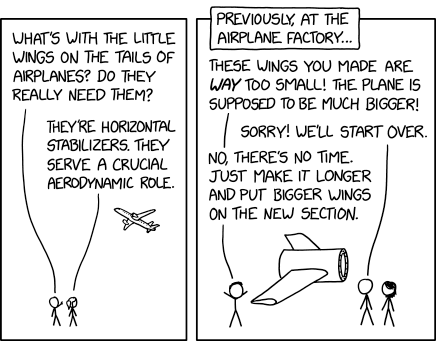
xkcd #3241: Horizontal Stabilizers
Title text:
It started as a mistake that everyone was afraid to admit to, and then it stuck because removing it ‘looks silly.’.
Transcript:
Transcript will show once it’s been added to explainxkcd.com
Source: https://xkcd.com/3241/
You must log in or # to comment.
They’re horizontal stabilizers. They serve a crucial aerodynamic role.

https://en.wikipedia.org/wiki/1983_Negev_mid-air_collision
In May 1983, two Israeli Air Force aircraft, an F-15 Eagle and an A-4 Skyhawk, collided in mid-air during a training exercise over the Negev region, in Israel. Notably, the F-15 (with a crew of two) managed to land safely at a nearby airbase, despite having its right wing almost completely sheared off in the collision. The lifting body properties of the F-15, together with its overabundant engine thrust, allowed the pilot to achieve this unique feat.[1]
The F-15 started rolling uncontrollably after the collision and the instructor ordered an ejection. Nedivi, who outranked the instructor, decided not to eject and attempted recovery by engaging the afterburner, and eventually regained control of the aircraft. He was able to maintain control because of the lift generated by the large areas of the fuselage, stabilators, and remaining wing. Diverting to Ramon Airbase,[2] the F-15 landed at twice the normal speed to maintain the necessary lift, and its tailhook was torn off completely during the landing. Nedivi managed to bring his F-15 to a complete stop approximately 20 ft (6 m) from the end of the runway. He later told The History Channel, “it’s highly likely that if I had seen it clearly I would have ejected, because it was obvious you couldn’t really fly an airplane like that.”[4] He added, “Only when McDonnell Douglas later went to analyze it, they said, OK, the F-15 has a very wide [lifting] body; you fly fast enough and you’re like a rocket. You don’t need wings.”[3][4][5]
Sometimes things aren’t as crucial as they might seem!
Ok, but passenger jets are just tubes with wings stuck to them, not a kite with rockets strapped to it…
Fighter jets are basically rocks that have huge jet engines strapped on to them, if it has propulsion, it stays on the air. But if it loses engines, it drops like a stone.
Crucial, but depending on the design technically not required! There are designs of planes where the entire plane is just one big wing. Buuuuuuut having the traditional rudder, aileron, and elevator is tried trued and reliable.
But if you understand how a lever works they can be really useful…
That’s exactly it. There are a lot of ways to design a fixed wing aircraft, a lot of viable wing configurations. But this particular configuration dominates most of aviation because there’s a huge advantage to having all your control surfaces way in back on the end of a long lever.
There are notable exceptions of course, flying wings like the B2 stealth bomber, delta wings with canards like the Erofighter. But both of those configurations are certainly less aerodynamically stable than the traditional arrangement. You really need to have some very important reason to design a plane differently, in those previous examples the reasons are stealth and speed.
I’m never sure where the joke ends, but everyone’s aware of dynamic stability right? The stabilizer pushes the tail down so flight is level, but if you lose lift, the tail goes up, the nose down, you gain speed, and lift is restored. If you gain too much speed, the tail is pushed down, nose up, you lose speed and level off.
Military jets have other priorities