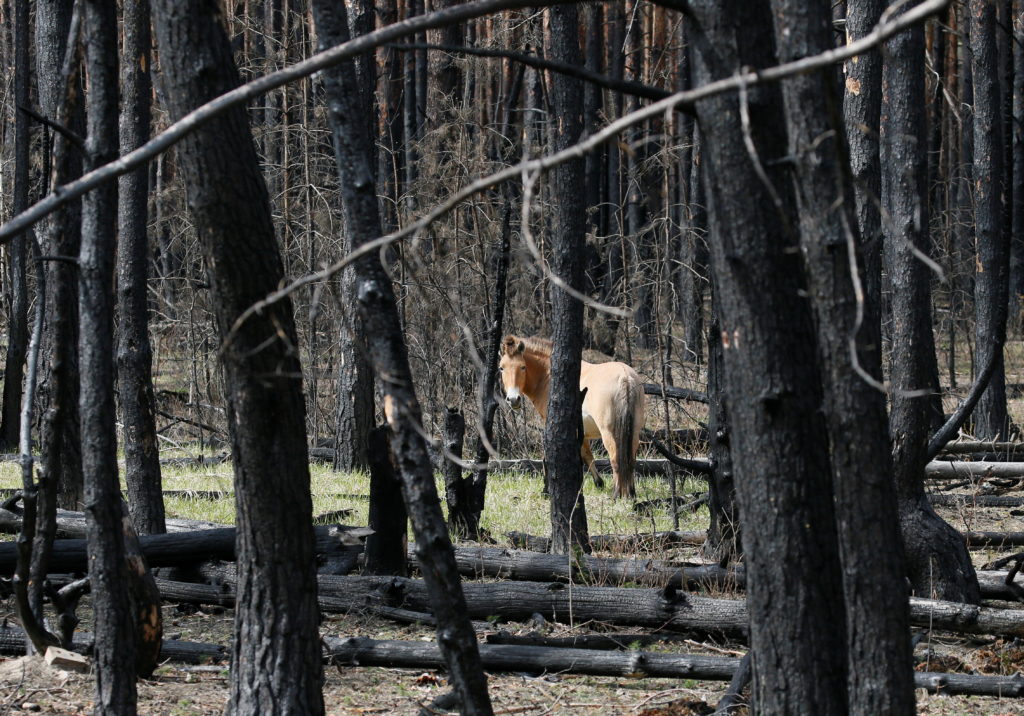
Wolves, bears and lynx have rebounded in the radioactive landscape, along with a rare breed of horses native to Mongolia. Scientists say it shows nature’s ability to recover when human activity is removed.
its the same with the DMZ in korea, the area where its heavily mined and forbidden to enter tigers, and other animals thrived there.
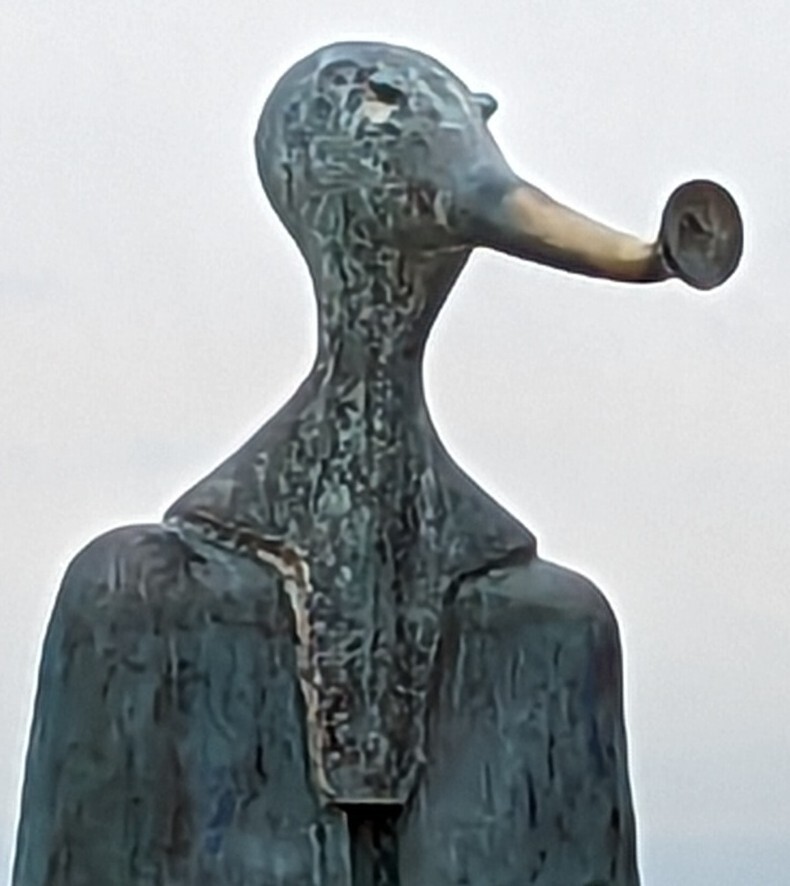
Beware of the Snorks, though
Reminds me of the 38th parallel in between North/South Korea. There has been a resurgence of rare wildlife there because no humans fuck with it.
Edit: here is an article about it
“The landmines are doing more for conservation than anyone…” Kim Seung-ho

Pictured: the threatened asianic black bear.
Soon, Deathclaws, soon…
Saw a huge Moose in Chernobyl once…
Everyone should! Let’s all book trips to the place with no humans and look at it, so we can take pictures and tell more people about it. It’s so calming and relaxing, we should go there more often. Maybe someone could sell some merch…
Honestly that is exacting how it went down, we all got handheld Geiger meters. On the entrance checkpoint there was a bunch of stalker (the game) merch.
The Chernobyl tours are an actual thing. You don’t get to wonder by yourself though, for obvious reasons. But you do get to see nature reclaiming the city.
if anyone is interested in more stories like this i definitely recommend reading “islands of abandonment” by cal flyn, which also has a chapter on chernobyl. stories of natural recovery in areas that humans no longer occupy.
My understanding was that radiation was harmful to wildlife, but less harmful than humans. So not exactly uplifting…
Really, the risk of radiation is pretty damn low. There are some hot spots, and maybe you’d find a hot piece of material (probably not) but it’s mostly just wilderness that has restricted access. It’s not dangerously radioactive. Even in Pripyt it’s mostly fine. You can even get close to the destroyed reactor and be OK. Keep in mind, the last reactor at Chernobyl only stopped operating in 2000.
its barely negligible apparently. the only danger is the red forest, and truffle,fungi that grow that which hyperaccumulates the radioisoptopes, they found the wild boars had hight amounts of those isotopes, they couldnt figuer it out until they found them eating the fungi.
THIS!
some people blindly react to everything “nature” or “non-humans” as purely good…
without thinking that maybe the animals moving to Chernobyl area might not be living their best lives, because the human-generated radiation is still there…
@FTonsilStones we’re all just biding time for the trees
Reassuring that the planet will be ok after

If humanity dies because of what humans did, and the rest of nature manages to continue on, I posit that humans are not classified as life.
Plenty of species self-destruct. The difference with humans is that we’re aware of our own self-destruction and are continuing it anyway.
This is a brave and hilarious take, you’re wrong but I’m giving you points for style
I mean, there are probably a ton of species that led to their own demise. The great oxygenation comes to my mind, but I bet there are many smaller events as well.
I wonder if those are those horses that were thought to be extinct, but it turned out they’re still around.
those are descended from domesticated horses(botai horses which is seperate from the current well know horses) not a true wild species, WIld horse species are pratically extinct since the last ice age, and they evolved in north america. other equine species do still exist like oangers, and zebras. its the prewelzakis horse.
there are spots on this planet with naturally high radiation levels similar to Chernobyl area. The threat is really to longer lived creatures like humans.
Humans demand a higher quality of life than animals.
We don’t get to see the bears, wolves, horses etc prematurely dying of cancer and mutations, but presumably their ability to reproduce happens before the radiation and mutations overcome their bodies.
presumably their ability to reproduce happens before the radiation and mutations overcome their bodies.
Good ole fashioned evolution baby
Interesting video regarding the topic: https://m.youtube.com/watch?v=j4OKo0VpoeM