- cross-posted to:
- programmer_humor@programming.dev
- cross-posted to:
- programmer_humor@programming.dev
You must log in or # to comment.
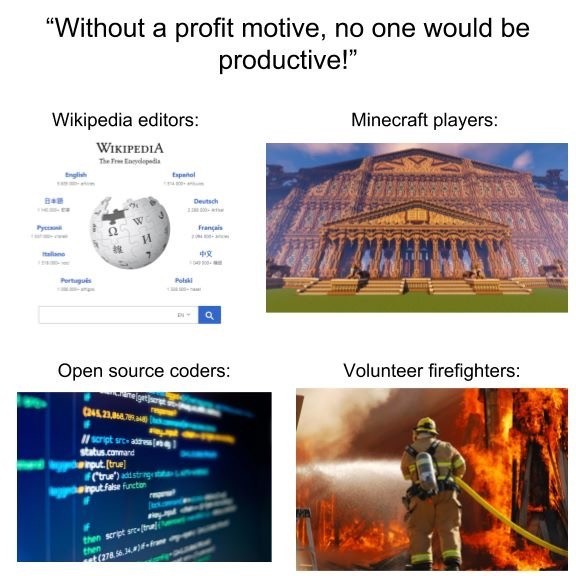
This is how you tell rich people have some serious mental health issue.
Decent people would rather a world where people worked because they enjoy that type of work rather than being forced to do it because they need money to live.
If you removed money, imagine where we’d all be as a society without the toxicity of money, wars and hate! :(
If you removed money, imagine where we’d all be as a society
Probably dead or living in the stone age.
There’s so many jobs that people don’t enjoy but are necessary. Nobody enjoys working in the middle of an australian desert at 40°C in a lithium mine. Nobody enjoys collecting your stinking trash. Nobody enjoys sitting in a store for 8 hours a day, scanning groceries. Nobody enjoys working in a warehouse for 8 hours.
However, these jobs and many more are vital for todays society.
toxicity of money, wars and hate!
You make it sound like wealth and wars are an invention of capitalism and not something that has existed basically since the dawn of time, even as something you can observe in primates, albeit on a much smaller scale.
Like, half of the jobs you listed would be automated out pretty quick in a world without money, out of the other ones, a few would be rendered obsolete without profit motive (pretty sure we can find something better for batteries than lithium, and why would you need someone scanning groceries if there was no money?). What’s left can be rotated out or done by lottery, and those doing the undesirable labor get to have more luxury items or whatever. It’s not hard to imagine, people have been doing it for centuries.
pretty sure we can find something better for batteries than lithium
Trust me, bro
would you need someone scanning groceries if there was no money?
Because this is the most efficient way of keeping track of how many goods leave your moneyless store, and ensuring assholes aren’t just taking everything for themselves and hoarding it. Tracking how many goods leave the store at any given time allows you to order an appropriate amount to keep things in stock so that people who need things don’t go without, and is especially important for perishable goods like fresh produce.
What’s left can be rotated out or done by lottery,
People have different skill sets and specialties. Many jobs take years of training and practice to reach an acceptable level. Also, you just invented state-sanctioned slavery/a non-military draft. What do you do with someone who refuses to perform their lottery-assigned job?
and those doing the undesirable labor get to have more luxury items or whatever.
That’s literally the system we have now, but more authoritarian, since someone has to decide what is a “luxury good” and how much undesirable work is required to attain a given level of luxury.
people have been doing it for centuries.
Citation needed. Concerns: authoritarianism; scaling; maintenance of the modern standard of living
I didn’t cite sources because the literal decades and decades of refutations to your arguments already exist.
But I will leave you with this: Why do libraries work?
If there are so many refutations, then it should be trivial to point me to one. Assume I am an idiot who doesn’t know how a search engine works - I very well might be. Would you be able to point me to one of these innumerable refutations that would disprove me - otherwise, how am I to learn?
Why do libraries work?
I’m not sure what you mean here. If you explain your point of view, I can explain mine. But I will point out that libraries are not a full, functioning society - just part of one.
Fine. Sure. A few starting points since you asked in good faith:
For historical examples of non-market/cooperative organization, see Elinor Ostrom’s Governing the Commons (1990), which documents real communities managing shared resources without privatization or central coercion. David Graeber’s Debt: The First 5000 Years also covers many societies that operated through reciprocity/obligation rather than modern monetary exchange.
I can point you to some great podcasts if you want.
For historical examples, Revolutionary Catalonia (1936–39) and numerous Indigenous communal systems demonstrate large-scale cooperative production/distribution outside traditional capitalist structures. See the previous Debt: the First 5000 years and just SO MUCH research. Maybe Orwell’s Homage to Catalonia would be a good place to look.
My library point wasn’t “libraries are a whole society,” but that they demonstrate distribution based on shared access/need rather than direct purchase can function effectively. Public institutions already allocate many goods/services this way.
As for undesirable labor, societies don’t need to choose between “profit motive” and “slavery.” Additional leisure, prestige, reduced hours, or enhanced benefits can incentivize difficult work just as effectively as wages. Automation can also reduce much of the repetitive labor currently done purely because it’s cheaper than innovating away the need for it.
I’m not claiming a moneyless society would be simple or easy—just that the idea humans can ONLY organize through profit incentives is historically and empirically false.
Society would collapse.
While working out of enjoyment instead of necessity is a noble and good goal. There are jobs that no one enjoys. Money can be used as an incentive to motivate people to work on jobs that aren’t that enjoyable, but still necessary.Living in a nice society is all the motivation people need. I hate doing dishes, but I do them because I hate living without clean dishes even more. Everyone understands sometimes we gotta do stuff we don’t like doing for a greater good. Acting like we need a wageslave class to do menial tasks otherwise we’d just let our world collapse is insulting our collective intelligence. We can share the burden.
Sure is a good thing doing this dishes is the most complicated and least-pleasant thing people can do…
Who’s gonna volunteer to go through years of training specializing in commercial diving in wastewater to treatment plants for free?
That seems kinda too idealistic view of the world.
I know much more people who, if not directly forced, would let the dishes or basically any environment around them completely mould and break down before even considering cleaning up even just the mess they have left behind, than people who altruistically do clean up after themselves and others.I do agree that living in a cleaner and nicer society should be enough of a motivation and for some it is, but there’s not enough of us.
We can already observe it in many public spaces where trash gets left laying around even if trash cans are available or public bathrooms or showers or my favorite example in the gym where plates get constantly left on the machines and cable attachments just piled up wherever those fell.
I’m not suggesting that we just leave everything to chance and just hope society maintains itself, I’m saying that we can structure society in a way that everything that needs to get done still gets done without the profit motive, because everyone inherently understands that if we evenly and fairly divide up the work that needs to get done, that they’re doing their part to live in a better world - does that make sense?
Living in a nice society is all the motivation people need.
You might want to read up on the bystander effect. You do the dishes because no-one else is going to do it. But as soon as there are others who can do the job people will just stand around and let other die before they put in the effort.
It sounds like you have never come across the concept of the tragedy of the commons?
The particular topic of waste disposal is a good one because we have good historical accounts of the transition from a free-for-all to regulated, paid profession. Take the example of Paris, which in the 17th century was infamous for its dirt and stink. Repeated efforts to force people to keep their own streets clean failed, and ultimately residents complained that if the King wanted the streets to be clean, he had better pay for someone to come and clean them. Eventually city officials managed to force (through threat of punishment) residents to sweep waste and mud into the middle of the streets, and pay people to come through and collect and remove it.
In 15th century Britain, nightmen removed waste from cess-pits and charged two shillings a ton. If there were enough people who just loved shoveling shit so much to do this without money changing hands, why weren’t they out doing that?
I’m actually very familiar with the idea of the tragedy of the commons.
Rather than re-cover well tread ground, I hope that you don’t mind if I quote from a relevant section of an Anarchist FAQ, and I encourage you to check the link I shared, as it goes into far more detail:
In reality, the “tragedy of the commons” comes about only after wealth and private property, backed by the state, starts to eat into and destroy communal life. This is well indicated by the fact that commons existed for thousands of years and only disappeared after the rise of capitalism – and the powerful central state it requires – had eroded communal values and traditions. Without the influence of wealth concentrations and the state, people get together and come to agreements over how to use communal resources and have been doing so for millennia. That was how the commons were successfully managed before the wealthy sought to increase their holdings and deny the poor access to land in order to make them fully dependent on the power and whims of the owning class.
[…]
In fact, communal ownership produces a strong incentive to protect such resources for people are aware that their offspring will need them and so be inclined to look after them. By having more resources available, they would be able to resist the pressures of short-termism and so resist maximising current production without regard for the future. Capitalist owners have the opposite incentive… unless they maximise short-term profits then they will not be around in the long-term (so if wood means more profits than centuries-old forests then the trees will be chopped down). By combining common ownership with decentralised and federated communal self-management, anarchism will be more than able to manage resources effectively, avoiding the pitfalls of both privatisation and nationalisation.
If you want a modern, real-world example of this which you may have actually experienced yourself, look no further than this medium we are using to communicate. The Internet is a great example. The Internet was a fantastic common space lovingly maintained and curated by individuals, with services and content provided freely. Corporations encircled it, and turned it into the torment nexus we have today. It wasn’t because of us, collectively, that spoiled the commons of the Internet - it was capitalism itself.
There are many things that people are willing to do for their own satisfaction, I don’t disagree with that. I don’t think waste disposal is one of them.
The “communal life” you’re talking about cannot exist in an urbanised society, because most people you affect in a city are not personally known to you, and there will be no opportunity for the social mechanisms we evolved to pressure us into doing the right thing. In a village of 200 people, if you throw your shit in the street, your neighbour, whom you know personally and whose opinion you likely care about, will complain. In a city of 2 million, if someone throws shit in the street you have no idea who it was, they’ve never met you, and what are you gonna do about it anyway?
Anyway, I should bow out now. I have no interest in discussing politics or economics with an anarchist.
Do you really believe everyone would act like a psychopath if they aren’t always directly accountable for their actions? And how does that differ from our current system?
I have no interest in discussing politics or economics with an anarchist.
That’s really too bad, because I’m sure you’d learn a lot! Anarchism is not what you think it is. Either way, have a great day, I wish you all the best. Solidarity forever!
I feel like that entire passage completely ignores the fact that last time the bulk of humanity lived a communal lifestyle, the number of humans on the planet was a few orders of magnitude smaller. It’s a fairly easy setup to maintain when settlements are small and the bulk of people’s time is spent as hunter-gatherers or subsistence farmers. As soon as you put a very large number of people into a city, the communal arrangement falls apart. And many people like living in cities. That genie is out of the bottle, and people are not going to be willing to go back to being a subsistence farmer in a commune.
I don’t see why we would need to give up modern agriculture, fertilizer, heavy machinery, or automation in order to abolish capitalism, can you explain why you feel that way?