

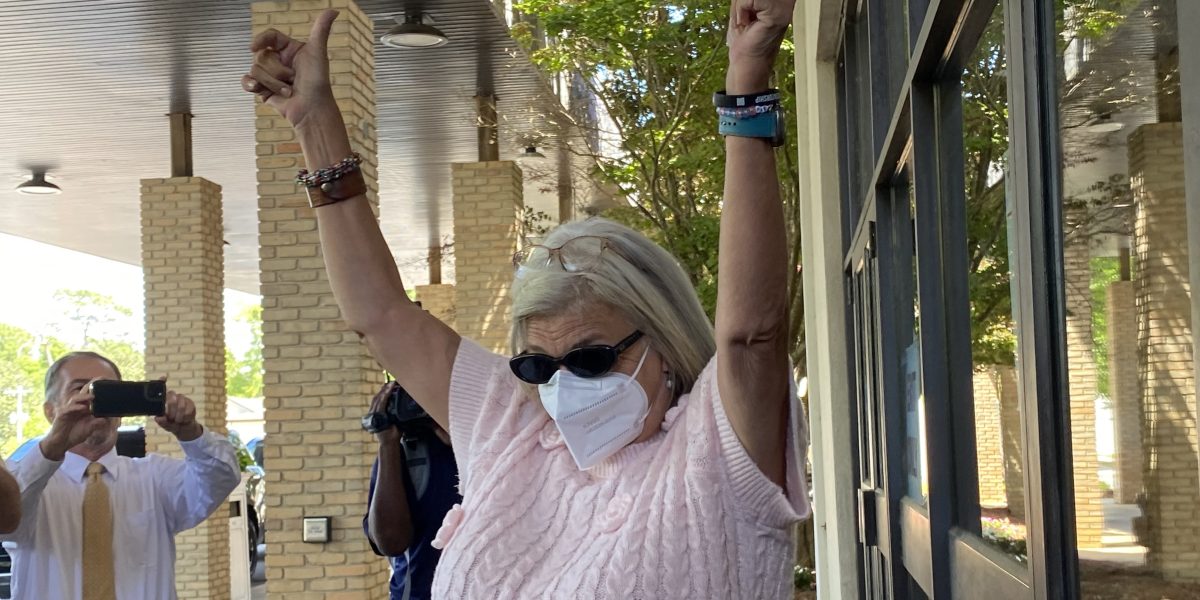
The trial of Renea Gamble had been underway for almost two hours when Marcus McDowell, the city attorney of Fairhope, Alabama, called a surprise witness.
“I call the gentleman in the red shirt,” he said, pointing toward a long-haired man in the second row. It took a moment to realize that he was referring to Gamble’s husband, 63-year-old Larry Fletcher.
Gamble’s defense attorney objected. He’d received no advance notice. But Fletcher shrugged and made his way forward.
Fletcher was with his wife when she was arrested at a No Kings protest in October 2025. She was wearing a 7-foot-tall inflatable penis costume and holding a sign that read “No Dick Tator.” Video of the incident went viral, turning Gamble into a minor celebrity and local free speech icon. Most people assumed the city would eventually drop the misdemeanor charges filed against her. Instead, McDowell added more, including giving a false name to law enforcement for identifying herself as “Aunt Tifa.”
Fletcher wore black Levi’s and a collared shirt with a Ferrari logo – a nod to his work rebuilding fuel injection systems for high-end cars. Sitting in the front row, Gamble looked a bit stricken watching the man she’d known since her childhood in Baton Rouge. “I know what she was thinking,” Fletcher later said. “She’s like, ‘Oh man, this could go out of control real easy.’”
McDowell asked Fletcher if he’d gone to bail his wife out of jail after her arrest. Yes, Fletcher said.
Did he make any statements to any of the jailers? Fletcher wasn’t sure. McDowell motioned toward one of the many law enforcement officers standing on the side of the room and asked if he looked familiar. Fletcher said he’d seen him around.
McDowell cut to the chase: Did Fletcher remember telling this man that he had gone to get bail money the day before the protest?
His objective was suddenly clear: The city attorney was suggesting that Gamble had gotten arrested on purpose.
If this was meant as a gotcha, things didn’t go as intended.
“I always make sure I have bail money!” Fletcher replied emphatically, as if this should be the most obvious thing in the world.
Did he have bail money on him now?
“Yeah!” Fletcher exclaimed, then gestured broadly. “With this many cops around? Come on.”
The room erupted with laughter. Moments later, Fletcher was back in his seat. Gamble reached back and held his hand.
I need someone who understands law better than myself to clarify here – not only did the prosecutor call a witness not on the list, but that witness was the spouse of the defendant?? I realize this is Alabama, and I may be a caveman lawyer (#notalawyer #notyourlawyer), but isn’t this wildly inadmissable? If this story is true, shouldn’t Cracker Jack lose their legal degree accreditation, because that seems to be where these participants got theirs? Or do l need to return to my cave?
I was thinking the same thing. Seems like that city attorney has taken a big ol’soak in a tub of reputational harm.
He can probably expect a promotion to the Trump administration any day now though. They seem to revel in hiring incompetent lawyers.
I’m pretty sure they’re still looking for a permanent replacement for Pam Bondi. He should submit his resume!
Job requirements:
She really did look like she was weaned on a pickle, didn’t she?
Long read here, but the story illustrates how the city attorney was scrambling less just to convict her than preempt a lawsuit she’s likely to file against the city. Doesn’t directly answer your question, but the context makes this clear that there were some desperation moves here.
I believe that the prosecution cannot call witnesses not on the list, but that the defense has more leeway?
Municipal court has slightly different rules, I think. At any rate, the defense objected and that would make it appeal-able post-conviction.
I mean, this court is set up for you to argue with the traffic cop as to how fast you were going. Calling witnesses usually isn’t a part of it.
My understanding is that calling someone not in the list is rare but not completely disallowed. You’d need some heavy justification and how the other side doesn’t object with better justification. I didn’t read the pay-walled article but the summary in the post made it seem very lackadaisical how it was handled. That would be very concerning.
As I understand it, litigators have pretty wide latitude to call whomever they want to provide factual testimony in support of their case. At worst, in some jurisdictions the opposing council has a right to be prepared and can ask for a recess while they do so.
And AFAIK states that grant spousal privilege limit that to private conservations, not overt acts or utterances made to a third party.
Typically you can invoke your 5th amendment right for spouses as well but you don’t have to.