

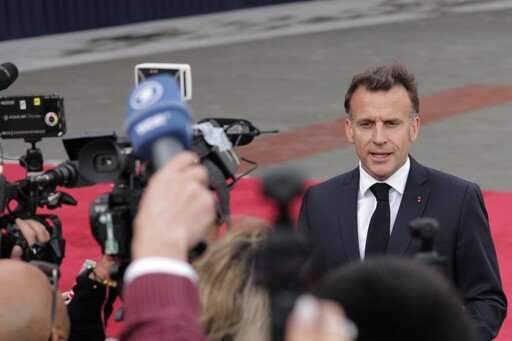
European leaders say President Donald Trump’s decision to pull thousands of U.S. troops out of Germany came as a surprise but is further proof that they must take care of their own security.
European leaders say President Donald Trump’s decision to pull thousands of U.S. troops out of Germany came as a surprise but is further proof that they must take care of their own security.
Yes, Europe must go it alone. It should negotiate with Putin regarding Ukraine. It should get together with Russia and China and negotiate with Iran.
there is no negotiating with Putin
Europe has been trying that since 2014
No, the negotiation is between Trump and Putin. Europe should be involved. Trump should not be trusted because events in Ukraine affects Europe more than the US.
This is what Europe should propose to Putin. Russia will withdraw from all land it seized from Ukraine after the 2022 invasion. NATO would be dissolved and replaced with a European alliance. Ukraine and Canada would be permitted to join but not the US. All sanctions against Russia will be lifted. Russia will not be required to pay reparations. If Putin doesn’t accept the proposal, the UK and France would send troops to Ukraine.
Europe has been attempting to negotiate with Putin before Trump ever entered the picture.
And the negotiations between Trump and Putin are just theatrics, nothing more.
Your proposal seems like a reasonable starting point on the face of it. But is unrealistic for several reasons.
The UK and France don’t have the political capital to threaten war on Russia. RN and Reform would likely dramatically surge in popularity.
Also Putin is obsessed with Novorossyia at a minimum and would interpret the threats of entry into the war as a bluff and try and call it.
And there are a lot of boomers still in charge who can’t accept that the Europe-US alliance has become transactional and thus unreliable.
The negotiations between Trump and Putin are not just theatrics. The problem is that Putin is demanding a lot and Trump presently is not willing to go that far.
The war in Ukraine cannot be allowed to continue forever. It is draining the economies of Europe. Europe could be facing the choice of fight now or later. It’s better to fight now while Ukraine is strong. The UK and France gave the Sudetenland to Hitler hoping it would stop his aggression. It didn’t. When Germany invaded Poland, the Uk and France declared war but did nothing. They should have attacked Germany from the west while much of Germany’s forces were in Poland. The result was that Germany later invaded France and despite considered one the world’s most powerful countries, surrendered in 6 weeks.
Dude do you seriously think people in power would solve this like mature adults? Representative democracy encourages maintaining the status quo since that’s better for votes than the risk of changing it. Dictatorship on the other hand encourages slow drainage and exploitation of resources and displays of power that’s how you prevent coups and foreign interference and keep your position.
In both cases it’s not the in the interest of governments to find the best solution that would benefit all parties.
Incorrect. A representative democracy must be in touch with what people want rather than keeping the status quo. The increasing popularity of far-right parties in Europe is causing centrist parties to adopt some of their policies.
Reality is much more nuanced but on average for representative democracy keeping the status quo is the safest policy. That’s why change is painstakingly slow in any direction. This is usually because the masses are either too polarised and/or fragmented that any change would cause too much heat. And/or people generally do be afraid of change and what the future holds. It’s simple human nature, that’s why we like to hold onto old items and why we enjoy nostalgia.
That’s an ideal scenario but personally I believe the modern systems of democracy in western societies are objectively too flawed for this scenario to occur and even when it does I don’t believe it’s sustainable. That’s why I think direct democracy and direct participation should be more ingrained in the culture.
What you say is idealistic and I do agree that it’s a good idea but reality is not a simulation and it’s definitely far from ideal. Politicians will always choose what’s best for them not for the people, sometimes that may align but it’s not a rule.
Putin won’t submit to Europe’s threat of war because he knows they’re bluffing and it’s true. European leaders have no real intentions of going directly into war. War is a too much of a big risk for European governments. If you don’t get every citizen in your country on board with war then you risk discontent which is not good in a representative democracy. You also risk tanking the economy and with the current global situation in the last decade I don’t think there’s anyone left who is willing to or even can absorb the shockwaves of a such major event.
This does prove my point. The far-right feeds on fear and what’s more scary than change. Be it economical change, demographic, cultural, religious, political, or even aesthetic change. They all share the same populist line “everything right now is evil and we need to do things the old way”. That’s how they recruit members. And usually people go with it until it’s too late.
P.S. I apologise if my writing is a mess it’s too late rn and English isn’t my first language.
It must not be a bluff. If Putin doesn’t accept my proposal, the UK and France must send troops into Ukraine. War would be costly, but sending weapons to Ukraine is straining Europe economies and what would Europe do if Putin is on the verge of victory?
People are willing to change if it makes sense. Equal rights for women and nonwhites are changes that many countries have accepted but some European countries have allowed a flood of migrants resulting in an increase in crime and fears that the cultural identity of the country will be changed.
Your English is very good.
I agree but unfortunately it’s not happening at least for now.
Unfortunately people don’t usually tend to plan for the long run especially when the outcome is not fully known yet. That’s why when we have the knowledge and technology to mitigate climate change and a lot of diseases, we have done so little compared to what we could be doing despite that the cost is lower than the total cost of damages in the future. If people in power think the cost is too high right now to be worth it, then the change becomes too slow, this is true especially when these people are of the older generations where the future outcome won’t effect them like it would do to younger generations.
True but that change faces high resistance from some groups and the system itself, and thus sometimes it’s decided that it’s not worth the backlash, the risk, and the cost even if everyone will benefit at the end.
I’m not saying change doesn’t happen what I’m trying to say is that it’s slow, hard and face resistance which only discourage it if it doesn’t have short term instant results. For representative democracies war doesn’t make since since the damage is short term while the benefits are long term which is the opposite of votes depends on. On the other hand, dictatorships don’t care about votes it only cares about the benefits for the rulers, therefore if they will have direct benefits they can just go for it.
You will only get war when the government no longer cares about it’s citizens and their votes (US), or the ideological and strategic benefits are too good to pass (Israel) or there is absolutely no choice.
True but I believe it’s more of a survival decision for some countries. For example where I live the government accepted refugees only because it meant they would get aid money and donations. For some western and European countries I believe it’s their aging population. The pension system became too expensive when you had more older individuals and less young people of working age. Immigration was a temporary fix to delay the eventual collapse of the welfare capitalist system due to the changing demographics.
This is my point. Even when lots of people accepted it still faced backlash and resistance from day one that has only increased ever since. This delayed establishing better systems and laws to allow integration and benefits for both native citizens and immigrants only making the situation worse and as a result hurting genuine hard working people who were willing to integrate.
It’s also worth noting that there are no strict rules when it comes to politics or sociology but rather a general tendency.
Thanks I appreciate it.
You are correct in that it’s unlikely the UK and France would want to send troops to Ukraine but that might change in the future. Suppose that Russia is on the verge of victory. Suppose that Europe is running out of money to support Ukraine.
The problem with immigrates in Europe is that some countries began allowing a flood of migrants without background screening. People would have tolerated migrants if only people with desired skills were admitted. This would also limit the number permitted to enter.