

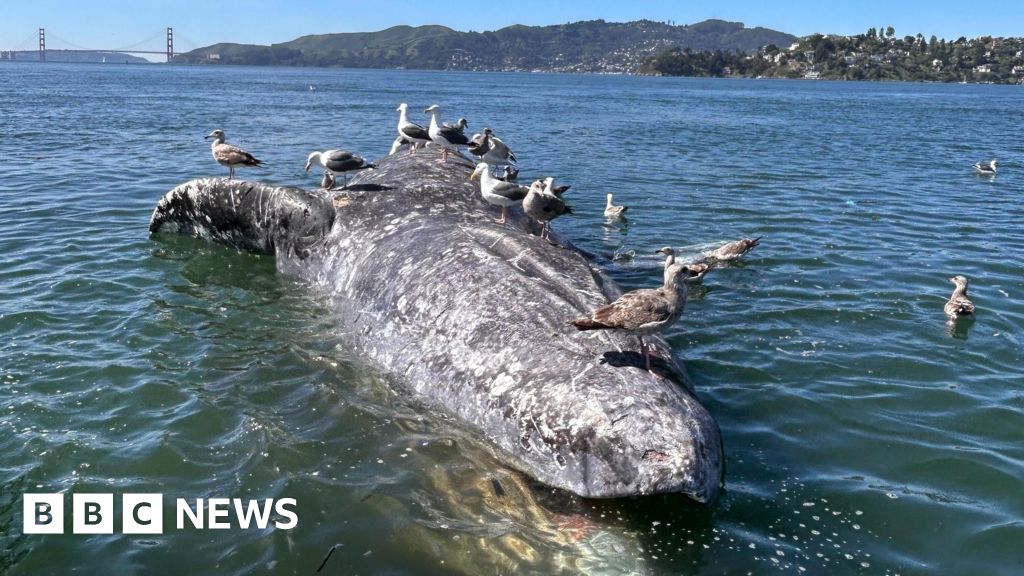
California’s blustery San Francisco Bay is home to the Golden Gate Bridge, commercial ports, public marinas and ferry boats. But more recently, a new sight is attracting locals’ attention: Eastern North Pacific gray whales.
The whales have brought wonder, as residents and researchers now get to closely observe how they feed, breed and socially engage. They’ve also brought growing unease: why are so many of them undernourished and dying?
In 2025, a record number of 21 dead gray whales were found in the broader San Francisco Bay. So far this year, seven have died due to a combination of dwindling prey availability, climate change and human causes, researchers say.
The 4,140-sq-km bay is the largest estuary on the west coast of the US. Before 2018, this species of whales wasn’t known to stop seasonally or consistently in the bay, bypassing it on their migration route down to Baja California and back up the Arctic, said Josephine Slaathaug, who led a recent study on gray whale mortality in the bay.
While a lack of food may be driving whales into the bay, it’s not necessarily starvation that’s killing them. In recent years, nearly one-fifth of the gray whales that have swum into the San Francisco Bay have died there, usually after being struck by ships, according to Slaathaug’s study published in the journal Frontiers in Marine Science this week.
It’s been happening up and down the west coast. It’s awful.
Military grade sonar?
