What about a tornado?
I’m pretty high right now.
It couldnt hurt provided you remove it immediately after the storm is over and you would need to use something substantially stronger than kitchen grade wrap. Think industrial pallet wrap and a LOT of it definitely a large expense and a mountain of work for a questionable level of protection.
Practically speaking though it could prevent a lot of minor storm damage and prevent it from becoming large damage, would definitely protect the windows to some degree and secure items so they dont get ripped off the house.
In both cases, borrowing the words of stand-up drunkard Ron White, “It’s not that the wind is blowing; it’s what the wind is blowing.”
The house itself should be well waterproofed, the problems come from broken windows, punctured roof due to falling trees, or in a tornado, just being pushed over.
if you want mold in your house, yes. better to reinforce the house, or build it out bricks/concrete. plus, plastics smells when it heats up overtime and degrades releasing chemicals.
modern houses are already wrapped in tyvek which is super strong but it is inside the exterior shell.
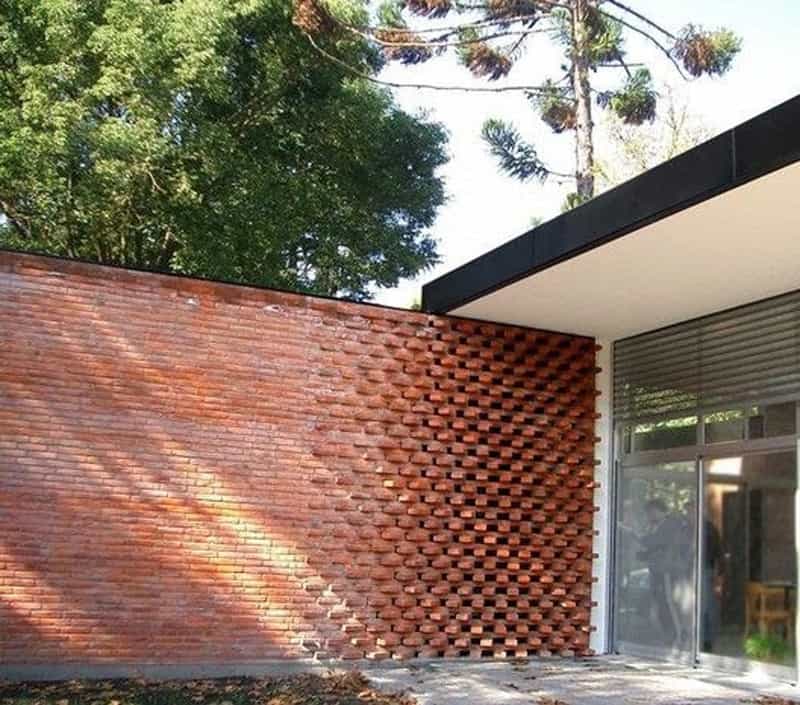
I grew up in Jamaica and our house didn’t actually have solid outer walls. Our house had decorative brick that allowed wind to blow through the house…without blowing it down. Our house is still standing today, and has survived multiple hurricanes.
Similar to the portion of the wall here closest to the house? https://cdn.designrulz.com/wp-content/uploads/2017/09/outdoor-brick-wall-design.jpg
Yeah…kind of like that.
Thank you for clarifying, because while I had a vague idea, I wasn’t sure.
Is it really a house if it doesn’t stop the wind or rain?
It has a roof…and interior walls, but no exterior walls.
So it’s more of a cubicle than a house then?
I think this would depend on the house being designed for this in the first place. A long time back I recall reading about how non-flow-through houses would endure high winds in a hurricane or tornado until one of the windows broke, at which point the hole in the house allowed the wind to ram air in (or suck air out depending on which way the hole was facing) and the whole house would disintegrate.
If my recollection is correct then there might be a slight benefit in the house-wrapping idea in that it might do a bit to prevent a hole like that from being taken advantage of. But only a slight benefit. Probably better to just do the traditional nailing of plywood over windows and such.
It would just be a waste of plastic.
This is like asking which color you should paint your house to prevent fire.
Gloss White, technically. It reflects more radiant heat from a bushfire. Not a game changer but could give a very mild advantage.
How about metallic paints? Want to test my chrome house against your white house.
It would create more of a barrier for wind and water to get caught in which could result in much more structural damage. My understanding is you WANT the air to flow through a house unabated in both situations as it would remove the instances of areas of very different air pressure which would result in essentially an air explosion.
So if there is a tornado coming, should I run around opening windows?
This is the correct answer.
Kind of - you’ll also get wind uplift if you have openings in those situations.
oh shit…
brick house, concrete, or wood house?
*brick house, wood house or straw house
Not by the hair of my chinny chin chin!
I swear I knew what it was going to be before I clicked on it
OR I’LL BLOW YOUR HOUSE IN!!
Houses are already wrapped with materials like Tyvek, before the exterior is put on.
I think wind is the biggest problem for hurricanes, unless you are in the storm surge. Wrap probably won’t help, and would get torn up by debris if the wind doesn’t rip it off. How thick are we talking?
How thick do we need?
Maybe like a foot to cushion your house when it lands.
I’ve through three major hurricanes: Irma, Ian, and Milton. Irma was okay, Milton was bad, Ian was baaad.
Short answer: nope.
-
It would not hold up.
-
New houses are built to crazy code anyway.
-
The big risk is flooding, and a tarp won’t do anything about it.
-
Yes absolutely
Having a proper, stable house would be a better option. Those American stick and cardboard houses are not made to last.
Materials like stone in a lot of the US would be deadly without constant, properly-running mechanical ventilation, for one. In a power outage in the south, people would die without it as stone buildings spend all day getting heat and radiating it back out. That type of house suits some cold climates fine, but is very bad in 35 degrees with 80% humidity. Likewise, in high-humidity environments, mold becomes a real issue without that mechanical ventilation (opening windows does nothing when outside is that humid and particularly when there is no wind).
In earthquake zones, you WANT flexibility; stone and brick are deadly as mortar joints fail and the structure collapses.
I think you underestimate how strong properly-built wooden-construction homes can be. There are also materials and cost issues to building with other things. Finally, as I started with, home construction should be appropriate to the climate in which the house is built with consideration for the local materials and safety.
Here in Japan, we have wood and steel-reinforced concrete. Rarely, you’ll find reinforced block, but I think that was a fad that passed. Anything brick-and-motor now has all kinds of steel bracing added for earthquake protection. The house I’m in is not far from Fukushima and survived the 2011-03-11 earthquake and tsunami with only a minor thing to be fixed (and some cosmetic damage to wallpaper). It’s made of wood.
That’s BS. In the Mediterranean we are used to be at nearly 40°C and 90% and houses are made of bricks and concrete. Even the cheaper ones. And no need for mechanical ventilation if the house is built the right way.
“the right way” is like “a basement”, right? Because that seems to be something too many American houses lack.
Depends on the area of the US. In the south, the water table is high enough that it’s usually not worth all the trouble trying to keep it dry. Same for most of Japan here.
Bricks breathe. Not sure about concrete.
As an example, I once lived in a brick house in the southwest. A true brick house, built in the 1930’s so EVERY wall was 3 or 4 courses of brick - 18".
The west-facing wall would bake all afternoon and then radiate that heat all night long. During the summer months that wall never cooled off, it was always warm (80°+).
Winter it was nice, but summer it was a bitch cooling that place at all.
Does wood still catch fire? I’m fine if I never have another house fire.
Thus, concrete and steel for me.
Ah, yes, good ole ignorant jingoism.
You probably don’t know that code in Florida has required concrete reinforced cinder block 1st floor for residential houses since the 90’'s, because that’s what can withstand hurricanes and flooding. Typical block construction only requires concrete and rebar reinforcement at windows, doorways, etc, while this code requires it in every other opening, thereby tying every course together, from first to last. This prevents flood surges from weakening the structure, and also provides a physical barrier for objects flying at 100mph+.
Code has also required hurricane straps on every rafter, since forever.
There’s probably a lot more code I don’t know.
But here you’d have them build houses out of stone which wouldn’t withstand flooding, unlike reinforced and anchored block, cause in your hubris you think you know something.
That’s Florida being ahead of the game. Although it is not much of a race.
But the “houses” in Tornado Alley? Sticks and cardboard all around.