

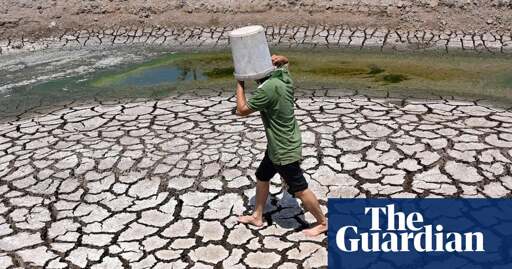
Global temperature record could be broken as soon as 2027, with El Niño expected later this year
A record-breaking hot year is almost certain by 2030 as the climate crisis intensifies, the UN’s World Meteorological Organization has warned.
With an El Niño event expected later this year, the global temperature record could fall as soon as 2027.
Carbon dioxide emissions from fossil fuels are continuing to rise, trapping more heat and driving more extreme weather, including the record-breaking heatwave that has hit the UK and Europe this week.
Global heating is already estimated to be taking one life every minute, with the toll likely to rise unless emissions fall rapidly.
What, exactly, is incorrect in my comment? There will be significantly more people in 2050 than there are today.
‘significantly more’ is around 10%, 20% if we solve climate change by 2050 btw.
That’s not that significant given we’re up 25% from 24 years ago.
But the important part is no, fertility rates have never been lower in world history, and they’re dropping faster than at any point in world history post-glacial-period-induced population squeeze. Most of the world is far below replacement, and the rest of the world is catching up thanks to the modernization of China and Africa.
By 2050 we will see a year where more humans die than are born. By 2100 there will be (actually) significantly fewer humans alive than there are today. We are two generations, at most, out from significant and rapid population decay, if not outright collapse.
Fertility rates, while interesting and relevant, were not what my comments were about.
My first comment made an observation that last year alone, we added the equivalent of the current population of the United Kingdom to the planet, and we’ve been doing that every year, for the past 70 years. (As an aside, I argue that the net addition is “significantly more.”)
My second comment remarked on the skewed perspective of looking at relative growth rates, which is why I specifically called out the human population in absolute numbers.
I fail to see how anything I’ve said is incorrect but I’m open to the feedback.
You were speaking about population growth. Fertility rate is the definition that we use for population growth and prediction.
I don’t believe you are reading any comments, or if you are you’re not understanding them because you believe you are right and there is no possible information that will ever make you believe otherwise.
Have a good life, it will be full of confusing and wonderful things that you will never be able to explain or understand.
I understand that, but again, that’s not the point of my comments. We’re talking about different things and I’m fully aware of lowering fertility rates.
I don’t know a better way to explain the motivation of my comments than that it is deliberately separating relative population growth (yes it absolutely has to do with fertility rates!) from absolute population growth.
I’ve been trying to encourage the reader to not think about fertility rates and just be in awe of the sheer amount of humans adding to the total population. The purpose of that thought experiment is to factor in that the growth shouldn’t be solely compared to a number from a previous period, because the growth doesn’t occur in a vacuum: the necessary resources here on Earth don’t grow at the same rate. Simply looking at a growth rate and saying it’s declining draws an extremely misleading picture.
I, too, genuinely wish you the best in life. However, I have no inclination to be passively aggressive about it.