

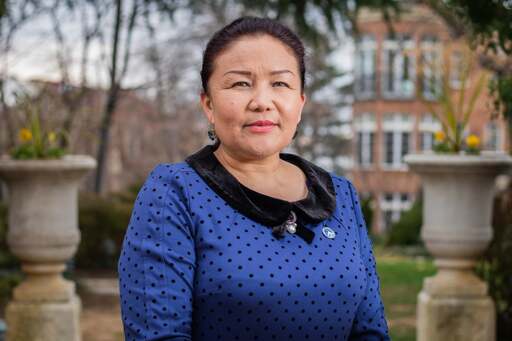
A woman who was tortured in one of China’s notorious Uyghur detention camps has launched a blistering attack on [UK Prime Minister} Sir Keir Starmer, accusing him of “disrespecting human rights” by approving plans for a Chinese mega-embassy in London.
Sayragul Sauytbay, an ethnic Kazakh who says she witnessed serious abuses when she was forced to work in one of China’s Xinjiang internment camps, accused the British prime minister of prioritising economic and political gain over international law.
“The recent activities of the current UK government have left us in deep anguish and fear,” she said, adding that Britain has “no right to speak about freedom and democracy” given its efforts to strengthen its relationship with President Xi Jinping’s government.
The activist, who is based in Sweden, now serves as the vice president of East Turkestan’s government-in-exile. In 2020, she led a complaint in the International Criminal Court (ICC) accusing Chinese officials of genocide and crimes against humanity, after fleeing China in 2018.
…
Speaking to The Independent, she detailed grave abuses in Chinese internment camps and recalled the horrors of the so-called “black room” in which detainees were tortured.
…
In the middle of the night in January 2017, Ms Sauytbay was detained for the first time by authorities in Xinjiang, an autonomous territory known as East Turkestan by several Turkic ethnic minority groups, including Uyghurs and Kazakhs.
She says she was interrogated on the basis that she had family in Kazakhstan, after her husband and two children had emigrated and gained Kazakh citizenship a year earlier.
…
At the camp, Ms Sauytbay says she witnessed horrific abuse of detainees.
“They engage in all forms of torture against the detainees, including both psychological and physical torture,” she said. “They routinely rape women. I’ve witnessed gang rapes as well with my own eyes.”
She says that a “black room” existed in the camp: a dark cell without any cameras where detention guards carried out torture against the detainees away from view.
…
“You can’t talk, you can’t cry, you can’t smile – even as an instructor, you can’t speak with the detainees unless it’s about teaching them,” she recalled.
When one batch of new detainees arrived, an elderly Kazakh woman ran to Ms Sauytbay crying. She hugged her, and told her she had committed no crimes. She was tortured as a result of the exchange.
…
“For several hours, they made me sit in the electric chair. They beat me. I thought I was going to die. Then, after they beat me up, I fainted. I woke up at 6am to the signal of the wake-up alarm of the camp, and pinched myself to see if I was just dreaming or if I was alive.”
Rape, she added, was a “very common occurrence” in the camp, with prison guards taking “whichever woman that they like”.
…
‘The UK is hypocritical’
Kazakhs and Uyghurs, Ms Sauytbay said, once looked to the United Kingdom for “hope and help”.
But in recent months, Downing Street has sought to repair the tense relationship between UK and China – despite Beijing’s human rights record and its alliances with Russia and Iran.
The prime minister advocated for a “more sophisticated” relationship with the Chinese government as he paid a landmark visit to Beijing in January, stressing the financial benefits of an improved relationship with the world’s second-largest economy.
Days before the visit, the UK had approved a controversial plan for a Chinese mega-embassy in London, criticised by many as a risk to national security.
…
Following a near-six-month stint in one of the detention camps, Ms Sauytbay was officially dismissed from her role at the kindergartens.
It was only a matter of days before the Chinese authorities returned to her door. Again, she was detained and interrogated in the middle of the night and told she would return to the camps for three years to be “re-educated”.
…
Ms Sauytbay fled for Sweden, where she now resides after being granted asylum. She is 4,500km from home - but does not feel she has truly broken free from the threat posed by the Chinese government.
“I don’t feel that I’m 100 per cent safe,” she said. “The CCP has a long reach. It has agents in all these countries. It’s able to use its influence and soft power to get its way and intimidate and silence people.
“The CCP’s increasing influence in democratic nations is not only a threat to the security of those nations, but it’s a threat to democracy, and it’s a very serious issue that needs to be confronted.”
…
Removed by mod
Removed by mod
Removed by mod
Removed by mod
Removed by mod
Removed by mod


