

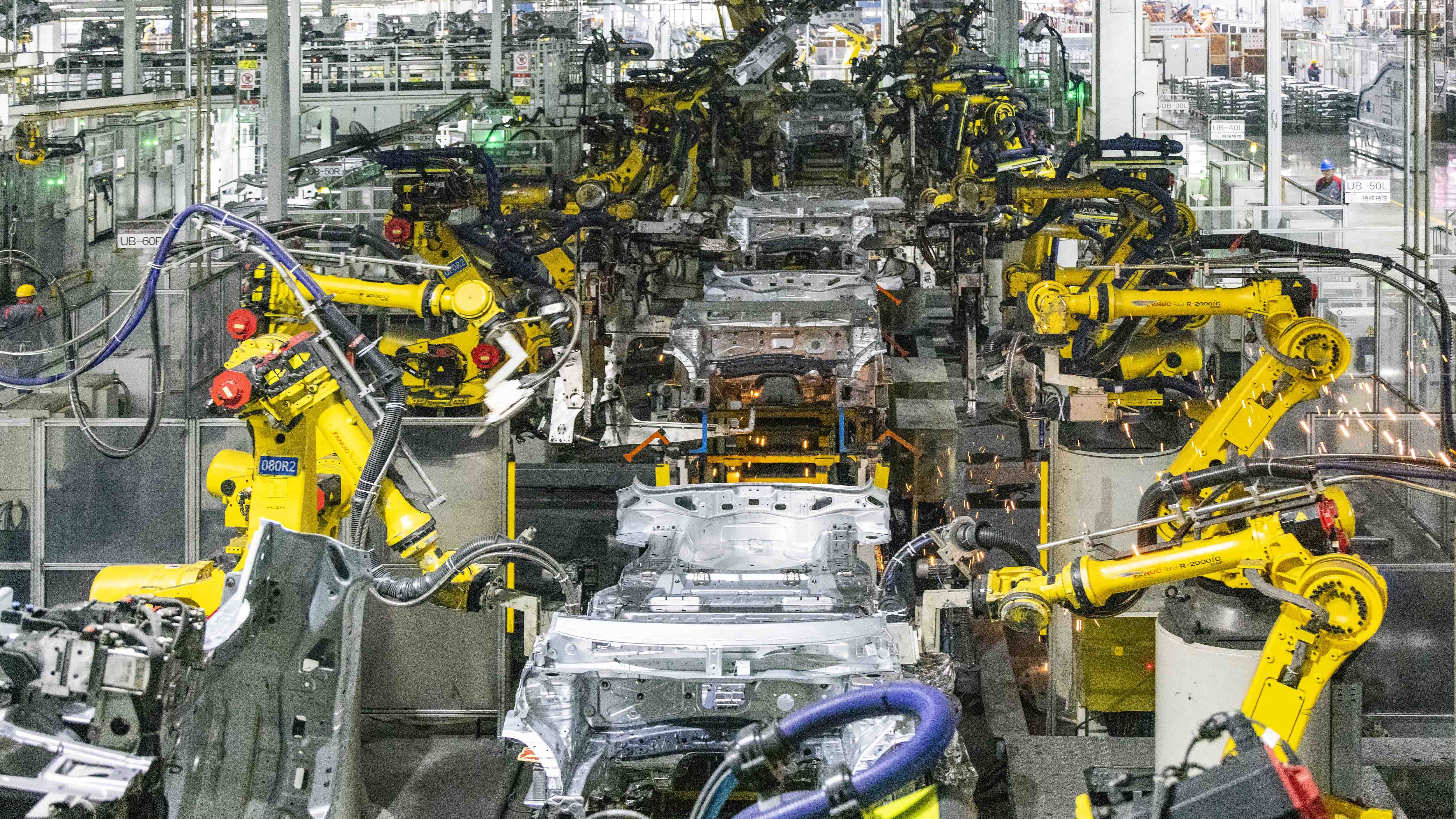
And, a recent tour of one of the Asian powerhouse’s vehicle plants has proved this beyond a shadow of a doubt, at least to Honda President and CEO Toshihiro Mibe.
“We have no chance against this,” Mibe said upon a visit to a Shanghai parts factory, commenting on its seamless automation across all levels of production. Logistics, procurement and all aspects of the process were so automated, in fact, that he did not spot a single human worker on the supplier’s floor.
Ford executives saying even three years ago that China was way ahead of the game
Toyota’s CEO has likewise said regarding not just his company, but the industry in general, “unless things change, we will not survive”
You got the country right. What’s your idea of a small car? When was the last time you drove in Australia? How large are the lanes where you live?
Of the cars you listed (or better said the website listed) only the Nissan Leaf is under 1800 mm width ( 1780 mm ). With a length of 4490 mm it’s not exactly a small car though, but I’ll grant you it’s within an acceptable size range for a vehicle. I haven’t seen many around tbh. The MG zs EV follows closely at 1809 x 4323, acceptable sizes but not small.
The Tesla T3, TY (you see these two a lot), Kia EV5, and BMW ix1 are well above 1900mm width. The T3, by far the most popular, is exactly 1933mm W x 4720cm L, the TY only 3cm longer. Hardly, hardly what I’d call a small car.
The other models listed are all above 1800cm width, and their lengths are over 4200 mm.
Let’s compare these sizes against popular PICKUP models. Ford Ranger: 1910 mm x 5225, Volkswagen Amarok: 1910x 5350, Mitsubishi Triton 1815x5305, BYD Shark3 1994x 5195, Nissan Navara 1850 x 5120.
TESLAS ARE WIDER THAN PICKUPS. Why??? Most other EVs have comparable widths to those of a pickup. Is that small?
Examples of actually small cars: Honda Jazz 1694mm x 3996, Toyota Yaris 1710x 3940, Suzuki Swift 1735x 3840, Nissan Micra 1665x 3780, Fiat Mini Cooper 1744 x 3876. These are relatively recent models. If you look for older ones, before 2020, you’ll find even more under 1600mm. Before the 2000s, you get cars even narrower than that.
New roads might take the current average car sizes into account, but nobody is broadening already existing streets.
Mate, you’re all over the shop.
So to address the initial point, I’m now in the UK where roads are much narrower than Oz, and yes I’m driving in Oz every few years.
The basic issue is not that small cars aren’t available in Australia, it’s that no one buys them. A holden or ford ute, or a Volvo station wagon was a large car in the 80s, now the supersized Yank trucks (and the Jap ones made for the American market) are everywhere. A Toyota Hilux now is massively bigger than it was 25-30 years ago. If people didn’t buy them, they’d stop selling them. The traditional ute was selling at the same time as the 4wds that got bigger and bigger - and wiped out their market share even before the Libs killed the car industry.
So. You can buy small cars in Oz, and you can buy small EVs - it’s just that no one actually buys them.
BYD Atto is small even by Euro standards,
https://bydautomotive.com.au/atto-1
ditto the Fiat 500
https://www.fiat.com.au/fiat/500e-electric
There’s probably more I can’t be arsed looking up.
Bottom line your issue is with your fellow drivers buying tanks instead of smaller cars, they exist, and many are in fact sold to city buyers, both in dino juice and electric versions