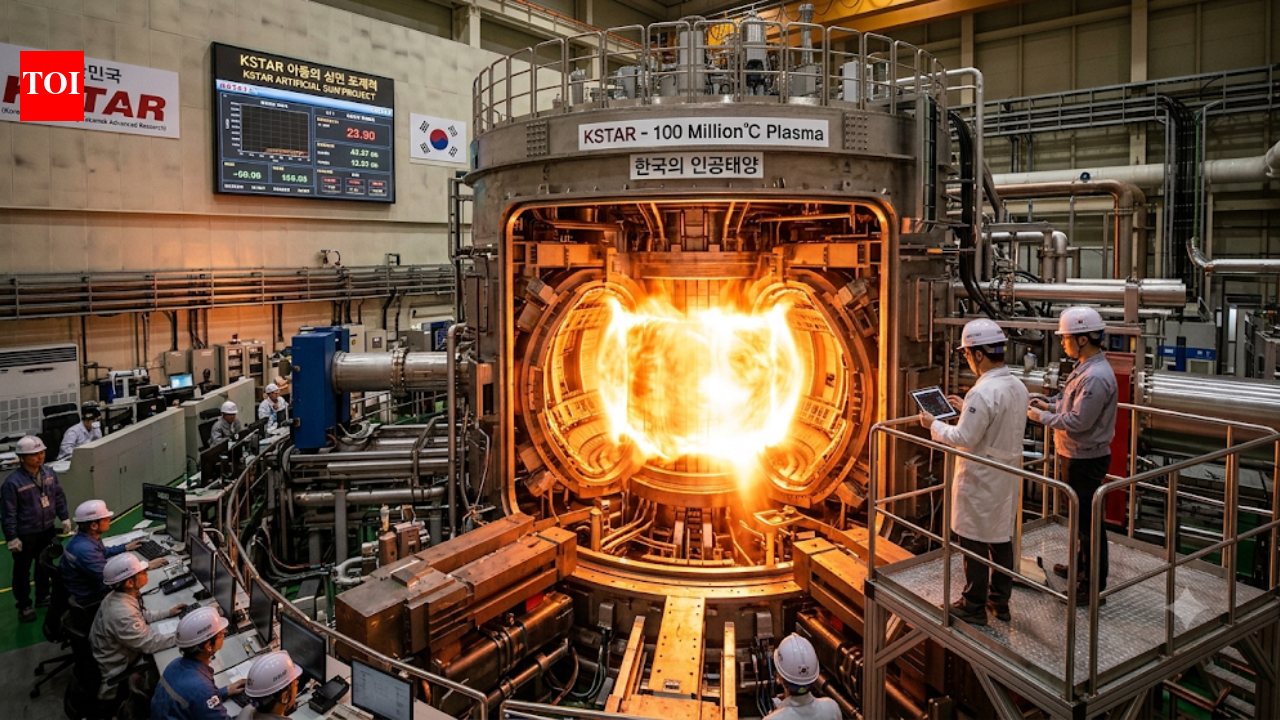
The South Korean artificial sun, which goes by the name KSTAR (Korea Superconducting Tokamak Advanced Research), has made an important scientific discovery concerning nuclear fusion by being able to sustain plasma in high-confinement mode for a period of 102 seconds while simultaneously managing to keep plasma temperature at 100 million degrees centigrade for 48 seconds. This development by the Korea Institute of Fusion Energy (KFE) is another move towards achieving clean fusion energy, whose ability to generate unlimited amounts of electricity with little to no carbon emission is promising.


I saw a talk from someone working in the field a few years back. The “fusion is only 10 years away” had a small proviso “if fully funded”. The actual funding was barely enough to keep the lights on.
That has now changed. It’s gotten close enough that private investment has decided it’s worth investing in. I believe the only really big problem left is the wall material. The neutron flux transmutes the elements making it up. This makes it difficult to maintain a hard vacuum, since the wall can start leaking and/or outgassing, forcing a shutdown to replace them. On a minor plus side, if you dope the walls with mercury, it transmutes to gold, in commercially viable amounts!
Fusion has several advantages over fission. The biggest is the impossibility of a meltdown. The very difficulty in balancing the reactor means that it shuts down fast and mostly clean. This would let them be placed far closer to population centers. They could provide a base load supply, in the way nuclear could/should have.
There’s literally a startup promising to exploit this. Although, how they’re going to get a commercially visible fusion reactor started remains to be seen